

No shooter puts a stranger set of demands on a mouse than Fortnite does. In the same one-second window you might need a clean, low-DPI flick to land a headshot, then three or four rapid, repeated clicks to throw up a wall, a ramp and an edit before the return fire lands. Most competitive shooters ask a mouse to do one of those things well. Fortnite asks for both, back to back, dozens of times a match, which is why the "best gaming mouse" lists built around Valorant or CS2 don't map cleanly onto this game. This guide is about the mouse specifically — sensor, DPI, polling rate, weight, shape and wired versus wireless — plus real models across three budgets. For the CPU, GPU and in-game settings that decide whether your PC can actually hold a frame rate worth reacting to, see our Fortnite setup guide; for the display side, see our 144Hz vs. 240Hz monitor breakdown. Neither is repeated here.
Quick Picks
| Tier | Mouse | Why it suits Fortnite | Typical price |
|---|---|---|---|
| Budget | Logitech G305 LIGHTSPEED | Zero-smoothing HERO sensor, reliable wireless, long battery life | Roughly $30-$50 |
| Mid-Range | Razer DeathAdder V3 (wired) | 59g ergonomic shape, 8,000Hz polling, clean Gen-3 optical switches for click-heavy building | Roughly $60-$70 |
| Premium | Logitech G Pro X Superlight 2 | 60g, HERO 2 sensor with a flat response curve, 8,000Hz wireless polling, no compromise anywhere | Roughly $150-$160 |
Nobody needs the premium column to play Fortnite well. It's for players who build and edit fast enough, and often enough, that a mouse's weight and click consistency are genuinely part of the skill ceiling rather than a nice-to-have.
Sensor Quality and DPI: The Flick Shot Problem
A sensor's job is to report your hand movement to the game with zero distortion, and the two failure modes to avoid are acceleration (where the same physical movement produces a different in-game distance depending on how fast you moved your hand) and smoothing (where the sensor averages out small, fast movements instead of reporting them exactly). Both are invisible during casual play and very visible the moment you're doing a fast 180-degree flick onto a peeking enemy, because that's exactly the kind of quick, high-velocity movement a bad sensor mishandles. Every mouse in the picks above — the Logitech HERO and HERO 2 sensors, and Razer's Focus Pro line — tracks with a flat response curve and no smoothing across its full range, which is the actual bar to clear, not the DPI number printed on the box.
On DPI itself: most competitive Fortnite players run surprisingly low sensor DPI, commonly in the 400 to 800 range, paired with a higher in-game sensitivity multiplier. That combination gives you fine control for lining up an AR shot at range while still being able to complete a fast 180 without lifting and re-gripping the mouse mid-turn. A mouse advertising 30,000 or 44,000 max DPI isn't buying you anything at these numbers — the ceiling is marketing copy. What matters is that the sensor tracks cleanly at the low end of its range, which is where you'll actually be running it.
Polling Rate: Where Building and Editing Actually Feel It
Polling rate is how often the mouse reports its position and button state to the PC per second — 1,000Hz reports every 1ms, 8,000Hz reports every 0.125ms. In a straightforward aim duel this is a small, arguable edge. In Fortnite's build-edit loop, it's a more real one, because editing pieces and placing structures is a rapid sequence of discrete clicks and key presses where the game is reading your input, not tracking a smooth cursor path. A higher polling rate shortens the average gap between you clicking and the game registering it, which adds up across a fast edit sequence the same way it does across a fast key-tap sequence on a keyboard. 1,000Hz is the practical floor for competitive play; every mouse recommended here clears it, and the mid-range and premium picks go to 8,000Hz. Treat that top-end number as a genuine but small edge on top of 1,000Hz, not the deciding factor between two otherwise similar mice.
Weight: The Fatigue Problem Hiding Inside a Flick-Shot Problem
A lighter mouse takes less physical effort to accelerate and stop, which matters twice over in Fortnite: it makes a fast flick shot a smaller physical movement to execute cleanly, and it reduces the cumulative wrist and finger fatigue of a match that's also asking you to click rapidly for structure placement the whole time. Sub-70g mice — the DeathAdder V3 at 59g, the Superlight 2 at 60g — are the practical sweet spot for competitive play; going lighter still exists at the enthusiast fringe but starts trading away shell rigidity and button feel for grams that stop making a measurable difference. A heavier mouse in the 90-100g range, like the G305, isn't a handicap for casual or even solid competitive play — it's a genuine trade of a little arm fatigue over a long session against a lower price, not a mistake.
Shape and Grip Style: Claw, Palm, Fingertip
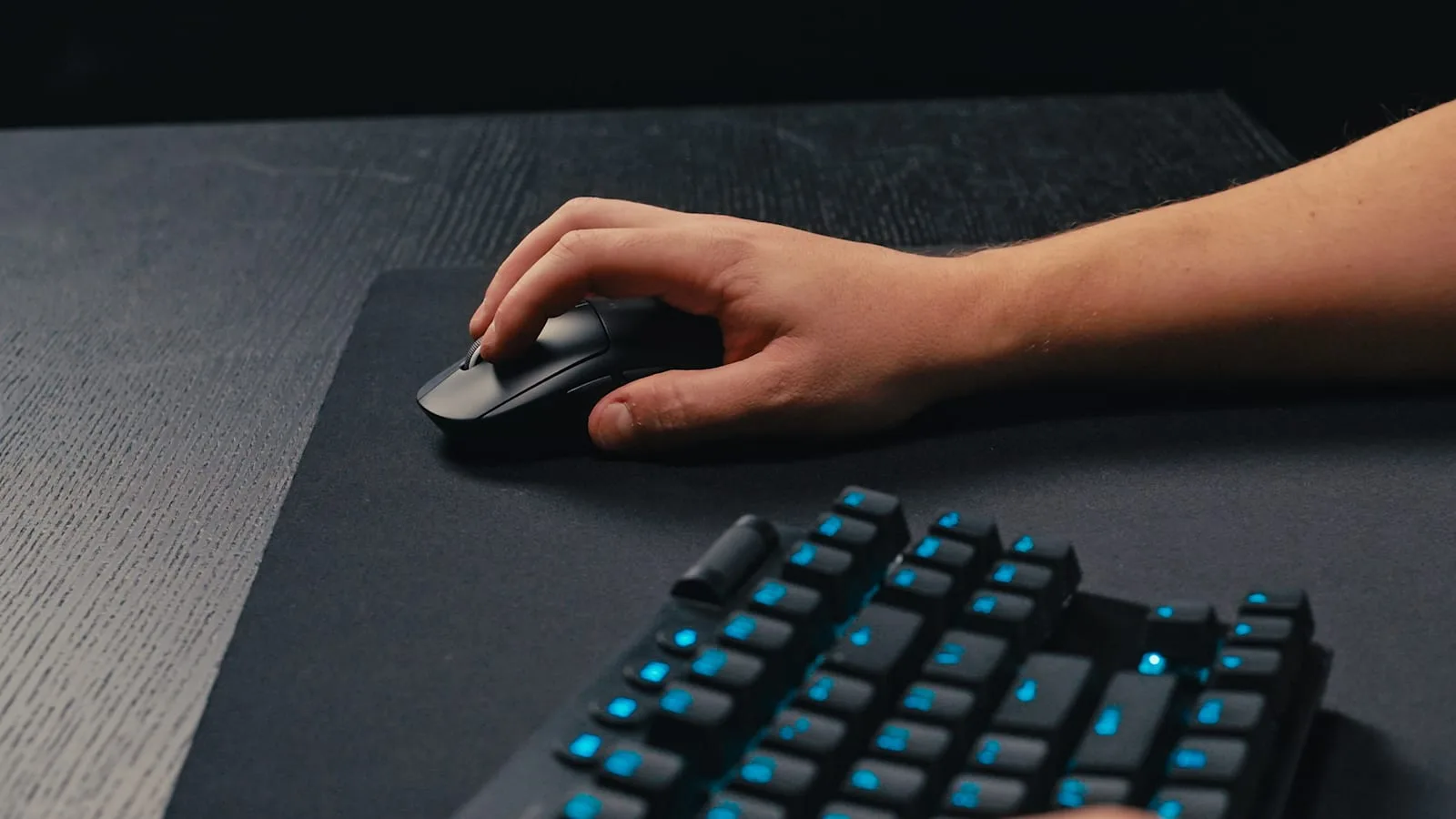
Fortnite's mix of precise aiming and rapid clicking makes grip style a real factor in which shape actually suits you, more so than in a game that's purely about aim. Claw grip, where the fingertips and lower palm bear the mouse's weight while the fingers arch to click, gives the fastest, most repeatable clicking motion — the exact thing rapid building rewards — and works best on a mouse with a slightly shorter, higher hump like the DeathAdder V3's ergonomic shell. Fingertip grip, where only the fingertips touch the mouse at all, maximizes flick speed and is common among players who prioritize aim over comfort in long sessions, and it pairs best with a lighter, flatter, more symmetrical shape like the Superlight 2's. Palm grip, where the whole hand rests on the shell, is the most comfortable over a long session and the most common grip among casual and mid-level players, but it's the slowest to reposition for a rapid click sequence, so if you're leaning heavily into competitive building, it's worth at least testing claw or a hybrid grip before assuming palm is right for you. There's no wrong answer for casual play — the wrong answer is buying a mouse shaped for a grip you don't actually use.
Wired vs. Wireless: This Argument Is Basically Over
For years, wired was the safe competitive default because wireless mice added real, measurable latency. That gap has closed. Modern wireless systems like Logitech's LIGHTSPEED and Razer's HyperSpeed run at the same 1,000Hz-to-8,000Hz polling rates as their wired counterparts, and independent testing consistently finds no meaningful latency difference against a good wired mouse at the same polling rate. What wireless still costs you is weight from the battery and a charging habit; what it buys you is a completely cable-drag-free flick, which matters more in a game built around fast, repeated direction changes than it does in a slower shooter. The Superlight 2 and most current flagship wireless mice both clear 60-plus hours of battery life on a charge, which is enough that battery anxiety isn't a real reason to stay wired anymore. If you're buying at the budget or mid-range tier where a genuinely low-latency wireless option costs a real premium, wired remains the more sensible default — that's exactly why the DeathAdder V3 pick above is wired rather than its wireless HyperSpeed sibling at a higher price for the same shape.
What to Actually Buy
Budget. The Logitech G305 LIGHTSPEED runs the HERO sensor — zero smoothing, zero acceleration, clean tracking from 200 to 12,000 DPI — in a 99g, AA-powered shell that lasts up to 250 hours per battery. It's heavier than the competitive picks below and its 1,000Hz polling is the floor rather than the ceiling, but neither of those costs you anything the average player will actually notice, and the sensor is the same honest, distortion-free tracking the premium tier is built around. It's the mouse to buy if you want to stop fighting your gear without spending competitive-tier money.
Mid-range. The Razer DeathAdder V3 is a 59g wired mouse with Razer's Focus Pro 30K sensor and Gen-3 optical switches rated for roughly 90 million clicks, running 8,000Hz HyperPolling. The ergonomic, right-hand-specific shape suits claw and palm grip well, and the light weight plus fast, consistent switches make it a genuinely good fit for a player who builds and edits a lot and wants that speed without paying premium-wireless prices. It's the pick for most players who've decided Fortnite is worth a dedicated mouse.
Premium. The Logitech G Pro X Superlight 2 is a 60g, ambidextrous-shaped wireless mouse running the HERO 2 sensor with a flat response curve up to 44,000 DPI and 8,000Hz LIGHTSPEED polling. Nothing about it compromises: it's light enough for fast, repeated flicks, wireless without a latency trade-off worth worrying about, and battery life (up to roughly 95 hours) long enough that charging is a once-a-week chore rather than a mid-session worry. The Razer Viper V3 Pro is the other mouse in this exact tier and is worth cross-shopping — at 54g it's a touch lighter still, with Razer's Focus Pro 35K Gen-2 sensor and the same 8,000Hz wireless polling, and it's reportedly the single most-used mouse among tracked competitive Fortnite players. Either is a legitimate top pick; the honest difference between them comes down to shape preference, not a performance gap.
Recommendation by Player Type
Heavy builders and editors. Prioritize weight and click consistency over raw sensor headroom — the DeathAdder V3 or Superlight 2, depending on budget, both clear the bar. A mouse that fatigues your fingers by the third box fight of a session is costing you more than a slightly slower sensor would.
Aim-focused, flick-heavy players. A lighter, more symmetrical shape like the Superlight 2 or Viper V3 Pro suits fingertip grip and fast 180s best. Run a low sensor DPI (400-800) with a higher in-game sensitivity multiplier rather than assuming a higher DPI number is doing work for you.
Casual and budget-constrained players. The G305 covers the only spec that actually matters at this tier — a clean, distortion-free sensor — for a fraction of the premium price. Don't feel obligated to chase 8,000Hz polling or sub-60g weight until you've hit a ceiling this mouse is actually giving you.

Lee covers PC setup and optimization for Gamingonix, translating requirements and settings into what actually changes your performance.