
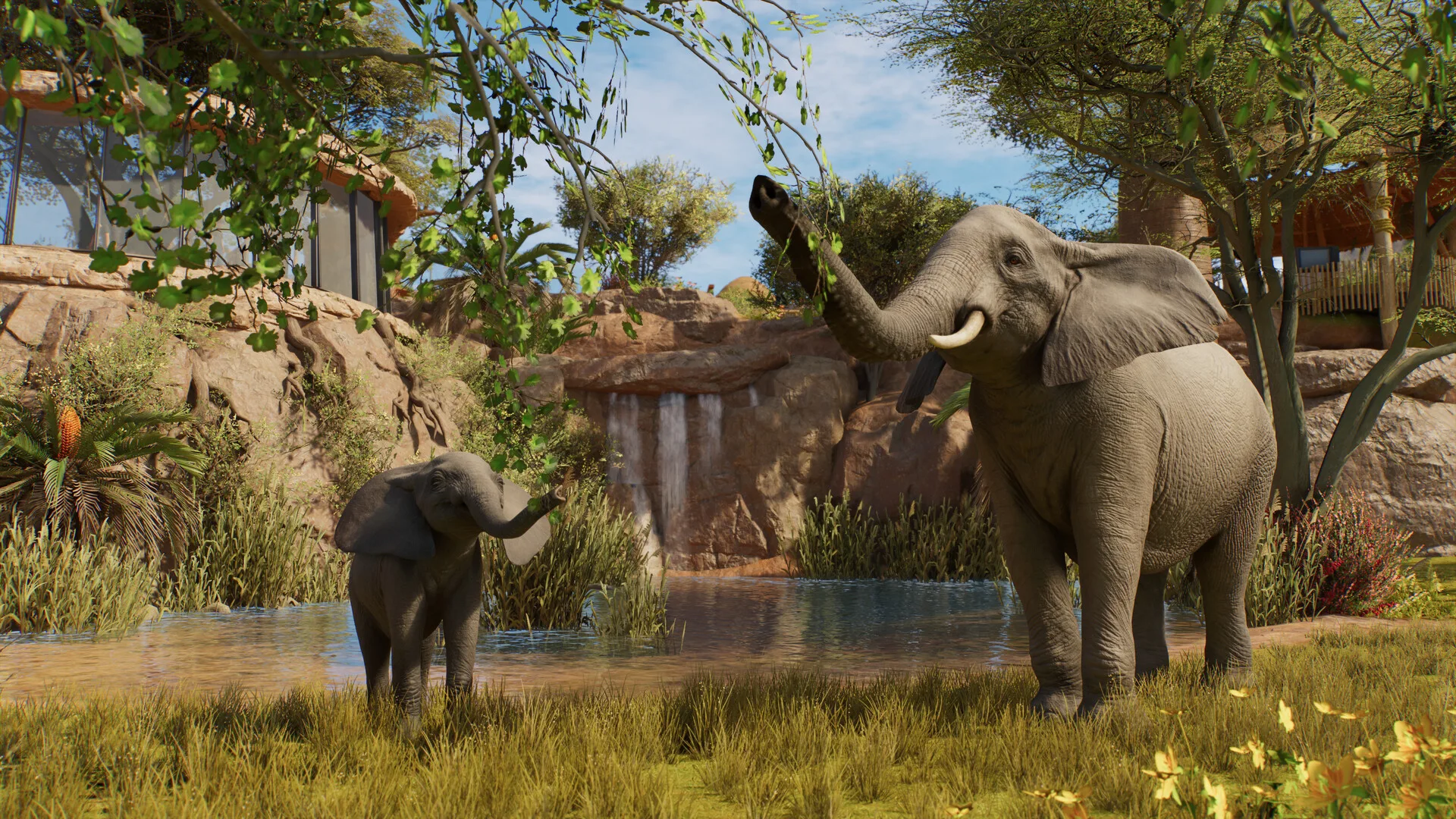
Planet Zoo, released in 2019, was never really about tycoon math. It was about standing a giraffe next to a fence you built by hand and feeling like you'd made something a real zoo architect might actually approve of. Planet Zoo 2, out October 13, 2026 on PC, PS5, and Xbox Series X|S, keeps that identity intact and then asks a bigger question of it: what happens after the animal is happy? The sequel's answer is Wildlife Reserves — open habitats you release thriving animals into once your zoo has done its job — and it's the single idea that justifies calling this a sequel rather than an expansion pack. Whether it's worth $49.99 (or $64.99 for the Deluxe Edition) depends almost entirely on whether you catch it before or after Frontier finishes patching it, because right now there are two different versions of this game's reputation circulating at once.
The Builder Toolset Got the Upgrade It Needed
The headline additions are aquariums and aviaries, and they fill a real gap from the original — Planet Zoo 1 had aquatic animals, but no way to build a dedicated tank habitat for fish, turtles, or sharks, and no equivalent for birds that actually fly rather than pace a themed enclosure. Both are genuinely new building categories, not reskins of the terrestrial habitat tools, and they open up a type of exhibit — a walk-through shark tunnel, a soaring free-flight aviary — that the first game simply couldn't offer. Scenery got a smaller but surprisingly load-bearing change too: objects can now be rescaled freely, so a boulder can shrink to a pebble or grow to the size of a double-decker bus, which sounds cosmetic until you're trying to match a rockwork backdrop to a habitat's actual terrain and realize how much friction that removes. Stack that against a launch roster of 136 animals — nearly double the 74 the original shipped with in 2019 — and the raw sandbox is simply bigger than anything the series has offered before, before you even touch a scenario.
Thriving, Not Just Surviving, Is the Real Design Shift
Planet Zoo's welfare system was already more granular than most management sims bother with, built around nutrition, social needs, a suitable environment, and enrichment, with health tracked as a related but separate concern. The sequel keeps that four-pillar structure but adds a state above "welfare met": Thriving. An animal that's merely comfortable survives; one that's Thriving — genuinely well-matched enclosure, social group, and enrichment, maintained consistently rather than in a single good week — lives longer and tolerates setbacks like disease better. It's a small distinction on paper that changes how you actually play: the old loop rewarded clearing a welfare checklist once and moving on, and the new one punishes exactly that complacency, because a habitat that slips from Thriving back to merely adequate has real, visible consequences down the line.
That loop now has somewhere to go. Conservation Credits let you adopt animals into your zoo in the first place, and meeting an animal's needs consistently enough to push it toward Thriving status and complete its linked conservation project is what graduates it out of your exhibit and into a Wildlife Reserve, where it's released to raise the reserve's Biodiversity score rather than sit behind glass for the rest of its life. It's the first time the series has built a mechanical endpoint for animal care that isn't just "keep it alive and don't let guests complain" — the goal is explicitly to not need the animal in the zoo anymore, which is a genuinely unusual thing for a management sim to want from its own core loop.
Career, Franchise, and Sandbox Ask Different Things of You
The series' three-mode split carries over with real differentiation this time rather than cosmetic difficulty sliders. Career drops you in as FEN's newest Conservation Coordinator across a chain of scenario zoos and reserves, each one built to teach a specific system — guest education, disease management, reserve ecology — and graded on medals that unlock the next tier. Franchise is the series' long game: you're managing a connected international network of zoos and reserves through the Planet Hub, moving animals and resources between them the way the original's Franchise mode moved them between theme-park locations. Sandbox, as ever, strips the training wheels entirely, with editable presets running from unlimited-resources creative mode up to a Challenge preset that reintroduces every constraint at once for players who want the tycoon pressure without the scripted scenarios. The practical effect is that Planet Zoo 2 doesn't make you pick between "builder" and "manager" the way a lot of sims force you to — Career teaches you the manager half, and Sandbox lets the builder half run unsupervised once you're done being taught.
A Great Game That Shipped With the Fences Down
Here's where the review gets complicated, and it deserves to be stated plainly rather than smoothed over. Critics were largely won over: Metacritic's critic aggregate sits in the low-to-mid 80s (84 on PC, 81 on PS5, 79 on Xbox Series X|S), and the praise across outlets centers on exactly the systems above — the welfare depth, the Wildlife Reserves, the sheer scale of the animal roster. Players had a rockier first few weeks. Steam's user rating settled into "Mostly Positive," but barely — hovering around 61% positive across several thousand reviews — and the written complaints are specific and consistent: random crashes, animals clipping through scenery or spawning in the wrong habitat, delayed inputs, and objectives that didn't trigger correctly in Career missions. One particularly bad stretch about a week after launch had a vocal subset of players calling the game effectively unplayable on certain hardware configurations. Frontier's response has been fast by the studio's own standards — a hotfix landed within 24 hours of release, two more patches followed in the first week, and patch 1.0.9 on November 5 specifically targeted a crash tied to in-game shop and souvenir-stand placement. That's a studio actively working the problem, not ignoring it, but it also means the Metacritic critic score and the Steam user score are, right now, describing two meaningfully different experiences of the same purchase.
Verdict
Planet Zoo 2 earns its sequel status on design alone — aquariums and aviaries fill a real gap, the Thriving welfare tier gives animal care an actual destination instead of a maintenance checklist, and Wildlife Reserves turn "release the animal" into a genuine, satisfying endgame rather than a throwaway flavor feature. The three-mode structure is more thoughtfully differentiated than the original's, and a 136-animal launch roster means there's more to actually build with than any previous entry in the series. Set against that: this was a bumpier launch than Frontier's track record with Planet Coaster 2 should have allowed, and anyone buying today needs to go in expecting to update immediately and still occasionally watch a zebra clip through a fence it has no business clipping through. If you can tolerate (or arrive after) that rough patch, the systems underneath are the most ambitious the series has built, and $49.99 is a fair price for a game this deep. Buy it for the Thriving system and the Reserves. Just don't expect zero friction getting there.
Pros:
- Wildlife Reserves give animal welfare a genuine endpoint — rewilding Thriving animals rather than just maintaining them forever
- Aquariums and aviaries are real new building categories, not reskinned habitats, and open up exhibit types the original couldn't do
- 136 animals at launch, nearly double the original's roster, with reanimated behaviors across the board
- Career, Franchise, and Sandbox are meaningfully differentiated rather than the same mode at different difficulty settings
Cons:
- Launch-week crashes, clipping, and broken Career objectives were severe enough to drag Steam's user score down into "Mostly Positive" territory at best
- The gap between critic scores (low 80s) and player sentiment is wide enough that your experience depends heavily on which patch you install on
- The four-pillar welfare system plus Thriving adds a genuine learning curve that will overwhelm players coming in cold off the original
- Some fixes (like the November 5 shop-crash patch) arrived weeks after launch, meaning early buyers paid full price to wait them out
Jack reviews games for Gamingonix, judging every release on its own terms and telling you plainly whether it earns your time.