
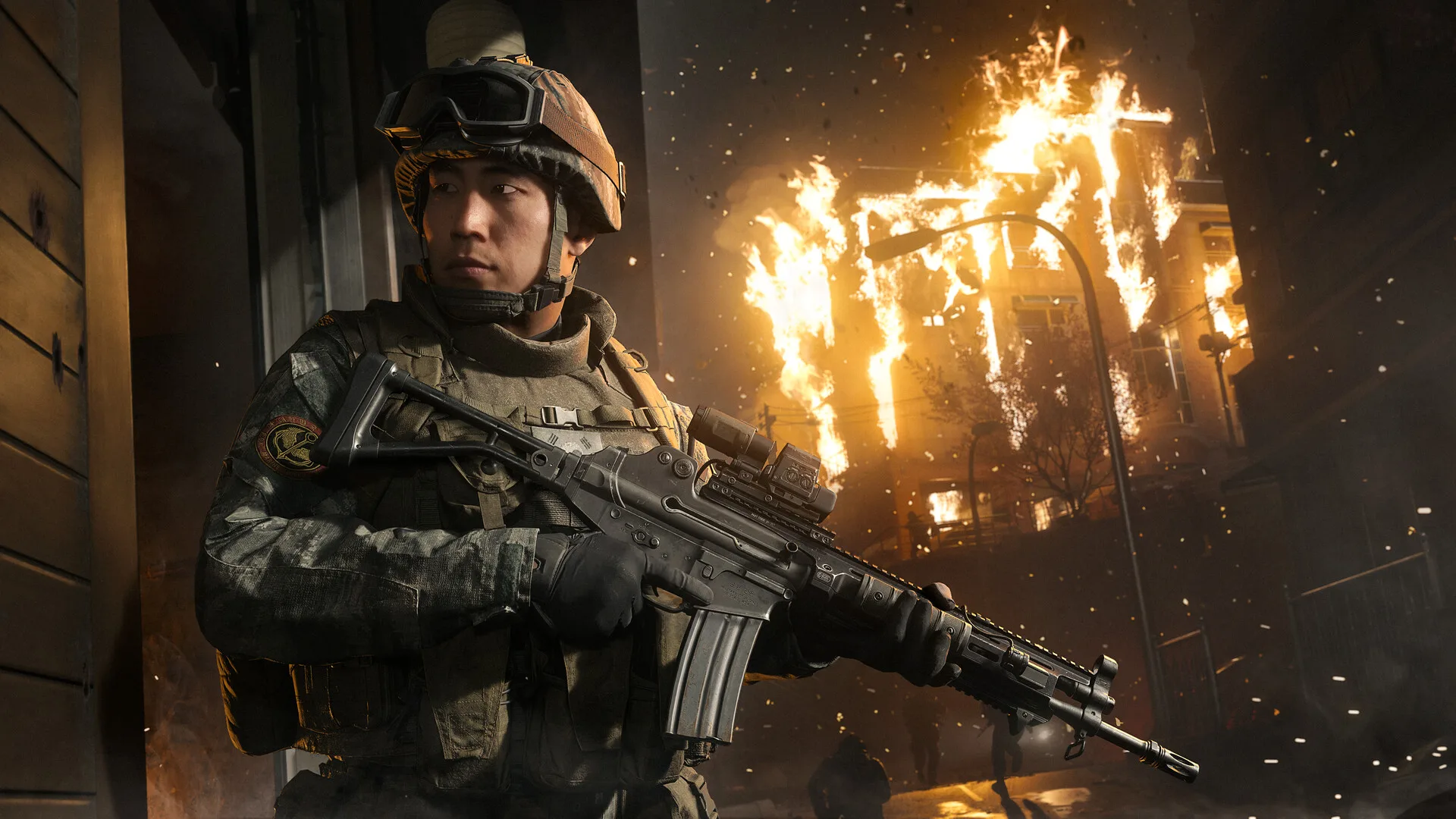
Call of Duty hasn't been this good at being Call of Duty since 2011. That's not a slight dressed up as praise — it's the actual shape of the critical reaction to Modern Warfare 4, which launched October 23 to the best review scores the series has posted since Modern Warfare 3, back when Obama was in his first term. After a decade of games apologizing for themselves in one direction or another — too slidey, too gimmicky, too AI-assisted, too safe — Infinity Ward has shipped something that mostly just does the fundamentals right: a campaign that actually closes a story arc instead of teasing the next one, gunplay that got heavier instead of faster, and an extraction mode built with enough conviction to stand next to dedicated genre specialists. It's not flawless, and the parts that are flawed are the parts this franchise always struggles with — but this is the most convincing Call of Duty has looked in years.
The Campaign Finally Lets Price Die
Modern Warfare 4 picks up with Captain Price AWOL, off the grid, and done waiting for Task Force 141's chain of command to catch up to what he already knows: Makarov's old network isn't finished, and the man currently finishing it — a cartel-connected fixer called The Archer, played by Mads Mikkelsen — needs to be dealt with personally. That takes Price into an uneasy alliance with Las Almas cartel boss Valeria Garza, a partnership built on completely incompatible rules of engagement that gives the campaign some of its best written tension: Price trying to keep civilians out of the crossfire while his new ally treats collateral damage as a rounding error. Meanwhile Kate Laswell, with no good options left, sends what remains of 141 to bring in their own captain, dead or alive, while North Korea launches an invasion south that the plot uses as its backdrop rather than its focus.
It's the most confident Modern Warfare campaign in years specifically because it isn't afraid to end things. Price dies on a frozen lake in the final act, taking The Archer down with a length of pipe after being gutted in the fight, with Ghost staying at his side through it — a genuine conclusion to a character arc that's been running since the 2019 reboot, not a cliffhanger dressed up as one. The mid-campaign open-world detour, built around a Las Almas hub where you forage supplies, rebuild outposts, and craft gear between story missions, is the better version of an idea this franchise has fumbled before: where last year's Black Ops 7 bolted an oversized Warzone map onto its story and asked players to trek across it for no good reason, Modern Warfare 4's version gives you a concrete reason to return to the same space — a different objective, a different threat, a reason the detour earns its runtime instead of padding it.
Graphics and Technical Performance Across Four Platforms
This is a genuinely good-looking shooter, and it's been engineered to scale sensibly rather than just running the same settings everywhere and hoping. On PC it supports hardware ray-traced global illumination, reflections, shadows and ambient occlusion, and independent benchmarking found most current GPUs clearing 60fps at 1080p and 1440p on Extreme settings without ray tracing, with the top tier of cards holding a steady 60fps at native 4K. The rough edge is CPU-side: traversal stutter shows up during campaign streaming on weaker chips, and the fix that's circulated since launch — manually capping the RendererWorkerCount value to match your physical core count rather than letting the game oversubscribe every logical thread — shouldn't be a setting players have to discover themselves.
Console performance modes are built around the same resolution-versus-framerate trade every shooter this generation makes, with one added wrinkle: on Xbox Series X and PS5, the 120Hz performance mode needs a display with variable refresh rate to actually deliver 120 fps — without VRR, that mode caps at 60. The straight 60Hz mode holds a steady dynamic 4K (closer to 1440p rendered), while 120Hz drops the internal resolution toward 1080p to get there; Series S scales both down accordingly. The real surprise is Switch 2, which runs the campaign at a smooth 30fps with environments and lighting that hold up far better than handheld Call of Duty has any right to, while DMZ targets 40fps docked and 30fps in handheld mode — both ends feeling stable rather than like a compromise bolted on to hit a release date.
Multiplayer Goes Grounded, For Better and Worse
The headline change is a deliberate one: Infinity Ward ditched the hyperactive slide-dive-wall-jump movement that's defined Call of Duty's recent entries and brought the pace back down to earth. Weapons have real weight behind them, muzzle flash and audio design keep targets readable instead of obscured, and the twelve launch maps — mostly traditional three-lane layouts — are the strongest set the studio has shipped since 2016's Infinite Warfare. Time-to-kill is slower than the last few Modern Warfare games, which has split the community loudly online even as critics broadly credited it with making gunfights feel more deliberate and less like a coin flip decided by who dove first. Team Deathmatch, Hardpoint, Domination and Search & Destroy anchor the mode list, Gunfight returns alongside a new 10v10 variant staged inside Kill Block, a battleground that physically shrinks and reshapes as the match goes on, and a new mode called Inflation adds a genuinely different objective loop to the rotation rather than just remixing capture-the-flag again.
Set against that: this is still a Call of Duty launch, which means the oldest complaints in the franchise showed up on schedule. Skill-based matchmaking has drawn immediate, vocal backlash for producing relentlessly sweaty public lobbies and queues that stretch out as the system tries to balance them, spawn logic on a few of the new maps hasn't held up under scrutiny, and Gunsmith's attachment system has grown dense enough that several reviewers flagged it as bloat rather than depth. None of that undoes gunplay that's clearly a step up — it just means the part of Call of Duty that critics don't fully control, the live online experience, is exactly as unresolved here as it's been for several years running.
DMZ Returns as a Real Extraction Shooter
The mode that's actually earned the most unqualified praise isn't the 6v6 arena stuff — it's DMZ, rebuilt from the ground up around Hajin City, a sprawling map stretching across a fictionalized North-South Korean border. This is a full extraction shooter in the Tarkov mold, not the beta-adjacent tacked-on mode DMZ was when Modern Warfare II introduced it: Dynamic Ops generate multi-step missions on the fly across the map, AI factions patrol with genuine persistence, weather shifts from clear skies to sideways rain mid-session, and cash earned on a run gets banked immediately rather than being lost if you die before extracting — a deliberate design choice that keeps the mode's risk curve gentler than its genre inspirations without making it toothless. More than one reviewer called it the best new extraction shooter they'd played this year, full stop, not just the best thing Call of Duty has bundled into an annual release. It's the strongest evidence here that Infinity Ward wasn't just polishing old systems — DMZ is the one part of this package that feels genuinely rebuilt rather than refined.
Verdict
Modern Warfare 4 is the best mainline Call of Duty has reviewed since 2011, and the reasons for that aren't mysterious: a campaign willing to actually end a character's story, multiplayer gunplay that traded speed for weight and mostly won that trade, and a DMZ mode confident enough to compete with dedicated extraction shooters rather than just borrowing their vocabulary. It isn't a clean sweep — SBMM backlash, spawn complaints, and Gunsmith bloat are the same unresolved multiplayer problems this series carries into every launch, and PC players with modest CPUs will want to fix the stutter settings manually before their first match. But those are frictions around the edges of something that gets its core identity right in a way recent entries haven't managed. If you've sat out the last few years waiting for Call of Duty to feel like Call of Duty again, this is the year it does.
Pros:
- The campaign gives Captain Price's story an actual ending, and its open-world detour fixes what Black Ops 7's version got wrong
- Grounded, weightier gunplay and twelve launch maps that are the strongest set since Infinite Warfare
- DMZ's rebuild around Hajin City is a legitimately excellent extraction shooter, not a tacked-on side mode
- Scales smartly across hardware, including a genuinely impressive Switch 2 port with stable framerates in both modes
Cons:
- Skill-based matchmaking is drawing the loudest launch-week backlash of any Call of Duty system in years
- Gunsmith's attachment system has grown dense enough to read as bloat rather than depth
- CPU-bound stutter on PC requires a manual settings fix the game doesn't surface itself
- Slower time-to-kill is a deliberate choice, but one a vocal part of the existing player base actively dislikes
Jack reviews games for Gamingonix, judging every release on its own terms and telling you plainly whether it earns your time.