
Most annual sports games earn their yearly release by adding a mode nobody asked for. NBA 2K27 earns its by changing how a jump shot works and how a defender is allowed to stop one, which is the part of a basketball game you actually touch for forty minutes a night. It launched September 4 on PS5, Xbox Series X|S, PC and Switch 2, and critics have landed in a wide band around it: the aggregates sit in the high 70s, with scores stretching from a 95 at GamersRD to a 60 at ComicBook.com. After a few weeks with it, I understand both ends of that range. The basketball is the best this series has felt in years. Everything wrapped around the basketball is where the argument starts.
The Court: Green Windows and Defense That Fights Back
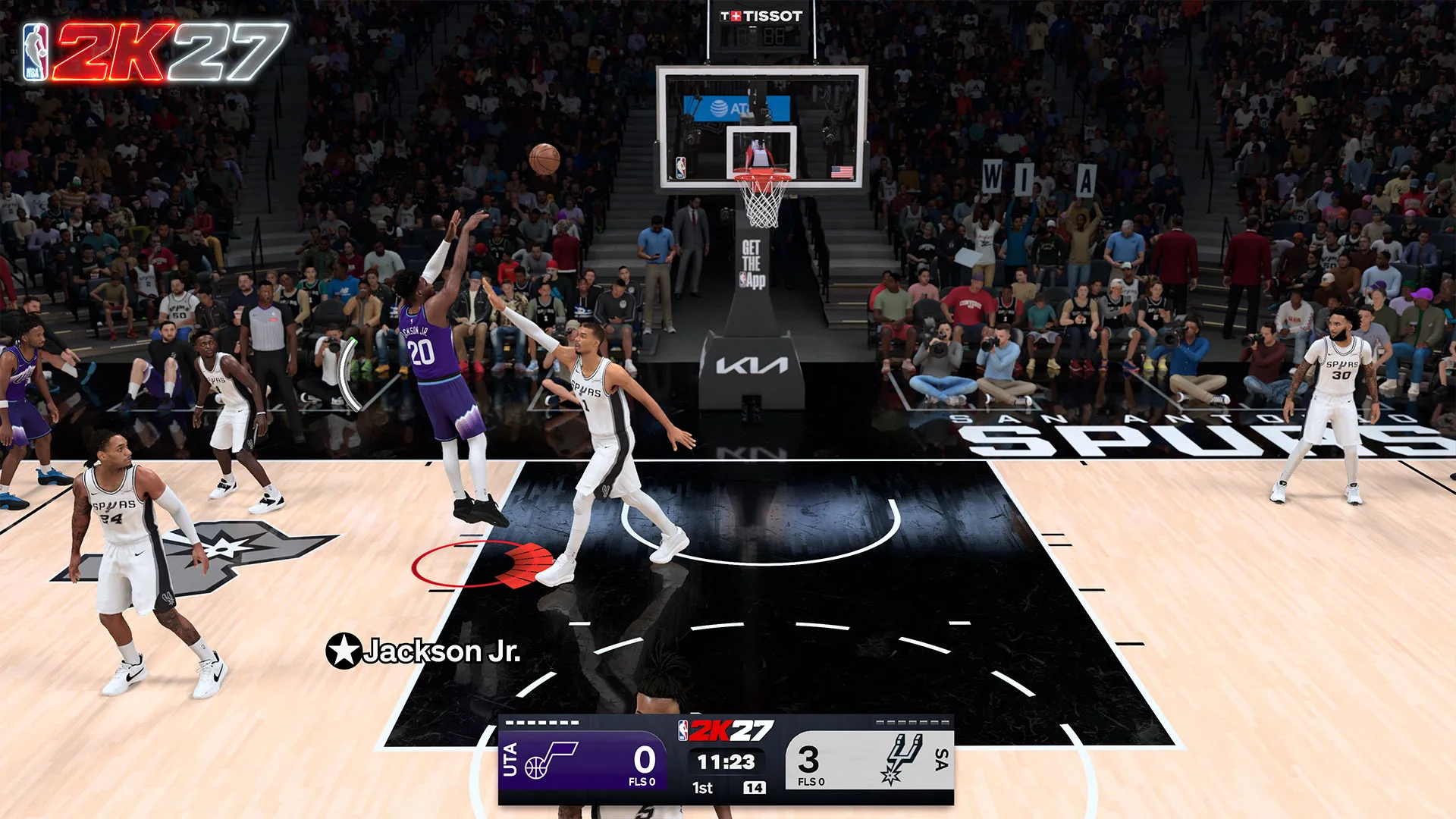
The shooting rework is the change that matters. Shots are now decided by a pure green window: hit your release inside it and the ball goes in, miss it and it doesn't, with no hidden dice roll settling the result after the fact. That sounds like a small philosophical tweak until you play a full game and realize how much more legible your own mistakes are. When a shot rims out, you know why. The windows are tighter than last year's, so expect your percentages to drop, and the game gives you levers to widen them. Slashers who beat their man with a first step and get into an open paint see a bigger window, while no-dip shooting now carries a penalty unless you've slotted the right badge. It rewards creating a good look rather than just launching from wherever the animation feels comfortable, and it lands closer to a sweet spot than 2K has managed since the "too easy, then nearly impossible" pendulum started swinging a few years back.
Defense is where the rebuild pays off most. Contests are now calculated relative to the shooter's position, and hands-up defense gives colour-coded feedback on the quality of a contest and where the pressure is coming from. It's a small piece of UI that changes how you defend, because you're finally being told whether you were late, out of position or just beaten. Driving lanes cut off more responsively, there's a new collision system for body-on-body contact, and dribbling has picked up a large batch of new animations that give ball handlers more weight. Game Informer's read that the pendulum is swinging back toward defenders is accurate, and I mean that as praise. Offense is harder, but scoring feels earned. Takeover is also reworked, rewarding strong play with attribute buffs and special skills instead of acting as a blanket power-up.
The complaints here are about feel rather than function. Several critics flagged movement changes that take adjustment, and the tighter windows will frustrate players who liked last year's forgiving rhythm. That's a real cost, but it's the cost of a shooting model that finally makes sense.
MyCAREER: Eras Are the Big Idea, Co-Op Is the Smart One
Letting you build a MyPlayer outside the modern NBA is the most interesting thing the series has done to its flagship mode in years. The five selectable eras (Magic vs. Bird, the Jordan Era, the Kobe Era, the LeBron Era and the Steph Era) come with period rosters, TV graphics and jerseys, and the point is that the league around you behaves like the league of the time instead of a modern one wearing a costume. Dropping a created player into a different decade changes the texture of a night's play, not just the uniforms. It's also a mode that will get more valuable if 2K adds eras later, which the studio hasn't confirmed.
The story campaign, Fire & Concrete, is an 11-chapter cinematic that runs more than twice the length of last year's, with Vince Staples playing your cousin Cam. It follows a former high school star whose path to college basketball was derailed, and you work your way back through streetball tournaments and the G League toward the NBA. It's one of the few recent MyCAREER stories that actually lets you spend time in the streetball world as part of the plot rather than as a detour, and it's a stronger showing than the mode has had in a while.
Co-op MyCAREER is the quiet addition I expect people to remember. A friend joins your save as Trace Miller, a custom G League running mate, and you share progression in games while each earning your own VC and experience. It solves a problem the series has always had, which is that MyCAREER is a solitary grind and the people you'd actually like to play it with are on the other side of a lobby screen. The catch is that it's still MyCAREER underneath, and the grind comes along with you.
Presentation: Still a Broadcast, Less of a Leap
NBA 2K27 remains the best-looking basketball broadcast in games. Arenas, lighting, court reflections and camera framing are convincing, and the era treatments go a long way toward selling the historical modes, with each period dressed in its own on-screen graphics. In motion, at game speed, it looks the part.
Stand still and the seams show. Player models no longer feel unquestionably ahead of the rest of sports gaming, and Legends are the weak spot: several classic players come out with off complexions or skin tones that pull you out of the moment, which is a bad look in a mode built on nostalgia. Critics who dinged the visuals weren't wrong that a real generational jump would have lifted the whole package. I'd describe this as a strong, polished, incremental year for graphics. I can't speak to how the Switch 2 version holds up against the other platforms, and I'd check performance impressions for that version before buying it, given it only gets the Standard Edition anyway.
The Modes Around the Court
MyNBA is still the deepest franchise mode in sports, and it now lets you run a league in the modern NBA or in eras spanning the last four decades. The new MyNBA Legacy adds a player-locked take on the same idea, blending front-office decisions with growing a single player into a legend. MyTEAM continues to be the card-collecting mode it always is, and if you're already in it, you'll know what you're getting.
The City is where the uneven off-court experience shows. Female MyPlayers now share spaces with male players for the first time, and the REC arena rotates through five settings, including a high school gym and an outdoor court, which keeps it from feeling like the same room every night. But the hub is still a maze of menus, storefronts and loading corridors that stand between you and a game of basketball. Pacing is a recurring critical complaint, and The City is the main reason.
Monetization: The Cost of Getting Good
This is the part of the review where I have to be blunt, because it's also the part where nearly every critic was. NBA 2K27 is a $69.99 Standard Edition that, once you're in MyCAREER, behaves like a free-to-play game. Virtual Currency is how you upgrade attributes, buy gear and unlock animations, and the earn rate doesn't come close to matching the cost. Third-party pricing guides put the top VC pack at $149.99 for 700,000 VC. Getting a player to 85 overall costs roughly 200,000 VC in attributes alone, and roughly 360,000 for 99. Those are estimates rather than 2K's own figures, but the shape is consistent: you either grind for a very long time or open your wallet. Game Informer put it well when it said the monetization makes the premium product feel more akin to a free-to-play game.
Co-op doesn't fix this, because both players earn VC separately and both still face the same wall. If you play MyCAREER purely offline and don't mind a slow build, you can live with it. If you want to compete online with a build that isn't visibly behind, the game is applying pressure on purpose.
Verdict
NBA 2K27 is two games in one box. The first is the finest basketball simulation in years: an honest green-window shooting model, defense that gives you the information to defend, more weighty dribbling and a MyCAREER mode with eras and real co-op that give it something new to be. That game deserves a score in the high 8s and I enjoyed playing it. The second is a storefront with a basketball game attached, and it's the reason the series' aggregate score lands in the high 70s instead of where the court action alone would put it.
I'm scoring it for both. It falls short of an Editor's Choice because the graphics were an incremental step, the off-court experience is still cluttered, and above all because the monetization is baked into how progression works, not bolted on at the edges. Basketball fans should buy this over last year's without hesitation if the on-court game is what they want, and the eras in particular are worth the price of admission. Anyone who plans to play MyCAREER online should budget for either a lot of hours or a lot of VC before they commit.
Pros:
- The pure green-window shooting model makes every make and miss readable, and the tighter windows reward creating good looks
- Rebuilt defense with colour-coded contest feedback, better cutoffs on drives and a new collision system
- MyCAREER Eras are the most interesting idea the series has added to the mode in years
- Co-op MyCAREER finally lets two people share one career
- Fire & Concrete is an 11-chapter story, more than twice the length of last year's
Cons:
- VC monetization makes a $69.99 game behave like a free-to-play one
- Player models no longer lead the genre, and some Legends have visibly off skin tones
- The City is still cluttered and slows the path to actually playing
- Tighter shooting windows and movement changes take real adjustment
Jack reviews games for Gamingonix, judging every release on its own terms and telling you plainly whether it earns your time.