
No other game has spent fifteen years getting rebuilt in public quite like this one. Minecraft has now sold more than 350 million copies — Guinness certified it as the best-selling video game in history back in 2025, roughly 120 million copies ahead of GTA V — and it did that not by staying the same block-punching game from 2011, but by quietly absorbing a graphics engine overhaul, a full combat rework, a movie that grossed nearly a billion dollars, and a switch to year-based version numbers that makes the old "1.21.6" naming look like a relic. The question a review has to answer isn't whether Minecraft matters historically. It's whether the thing you'd install today — Vulkan renderer, Marketplace storefront, sulfur caves and all — still earns its reputation as the genre it invented, now that a decade of survival-crafting competitors have had time to copy its homework.
The Loop That Never Needed a Sequel
Strip away every update and Minecraft is still built on the same three-word pitch: mine, craft, survive. You punch a tree, get wood, make a crafting table, and within twenty minutes you're deciding whether to dig straight down (still a terrible idea, still tempting) or explore laterally toward whatever biome the seed dropped you next to. What makes that loop hold up after this many years is how cleanly the risk curve escalates without a quest log ever telling you to escalate it. Hunger forces you outward from a cave; darkness forces you back toward shelter; a creeper's hiss forces a decision in under a second. Nothing about survival mode is complicated in isolation, but the way scarcity, light level, and mob spawning interact means every session generates its own stakes without a single scripted objective.
Combat got a real structural rework in the Tricky Trials update and its follow-ups — the mace, trial chambers, breeze mobs, and wind charges gave melee a genuine skill layer (mace damage scales with fall height, which turns vertical positioning into an actual combat decision) after years of PvE combat being little more than left-click spam. It's still not deep in the way a dedicated action game is, and the underlying hit detection can feel imprecise against fast mobs in tight spaces, but it's meaningfully better than the game most people remember from a decade ago. Exploration carries the loop the rest of the way: biomes stack meaningfully different resources and dangers, structures like ancient cities and trial chambers reward genuine risk with genuine loot, and the game never gates a new discovery behind anything except the willingness to keep walking.
Redstone, Command Blocks, and the Game Inside the Game
The single hardest thing to explain to someone who's never played Minecraft is that a meaningful percentage of its player base isn't building houses at all — they're building computers. Redstone dust, repeaters, comparators, and the crafter block form a functionally complete logic system, and the community has used it to construct working calculators, flip-flop memory circuits, in-game Turing machines, and automated farms that harvest crops, sort items, and smelt ore without a player touching them. This is the part of Minecraft no competitor has meaningfully replicated: a sandbox that layers actual computational depth on top of its building tools, so the ceiling on "what can I make" scales from a cottage to a functioning 16-bit arithmetic unit, depending entirely on how far down the rabbit hole a player wants to go.
That depth is also Minecraft's steepest and least-signposted learning curve. There's no in-game tutorial for redstone logic gates; everything technical players know, they learned from YouTube tutorials and wikis, which is either a charming extension of the game's build-your-own-knowledge ethos or a real accessibility gap, depending on how much patience you brought with you. Creative mode's unlimited resources and flight make large-scale building and redstone experimentation dramatically less tedious, and it remains the mode most long-term players actually spend their time in — survival gets you attached to the world, creative is where you actually build something worth screenshotting.
What 2026 Actually Added
Mojang switched to year-based version numbers this year specifically because the old numbering implied Minecraft was winding down toward some final 2.0; the year format says the opposite, that updates are an ongoing calendar commitment rather than a countdown. The releases back that up. Chaos Cubed, Java's June 2026 drop, added sulfur caves and the sulfur cube mob alongside an experimental Vulkan renderer, and the upcoming Wilderness Bound update (September 15, both editions) adds a dappled forest biome with its own furniture set and an abandoned camp structure. Neither is a headline-grabbing overhaul on the scale of Caves & Cliffs, and that's a fair criticism of Mojang's current cadence — updates now arrive smaller and more frequent rather than in the sprawling, multi-year packages the community got used to — but the frequency means the game genuinely feels alive rather than archived.
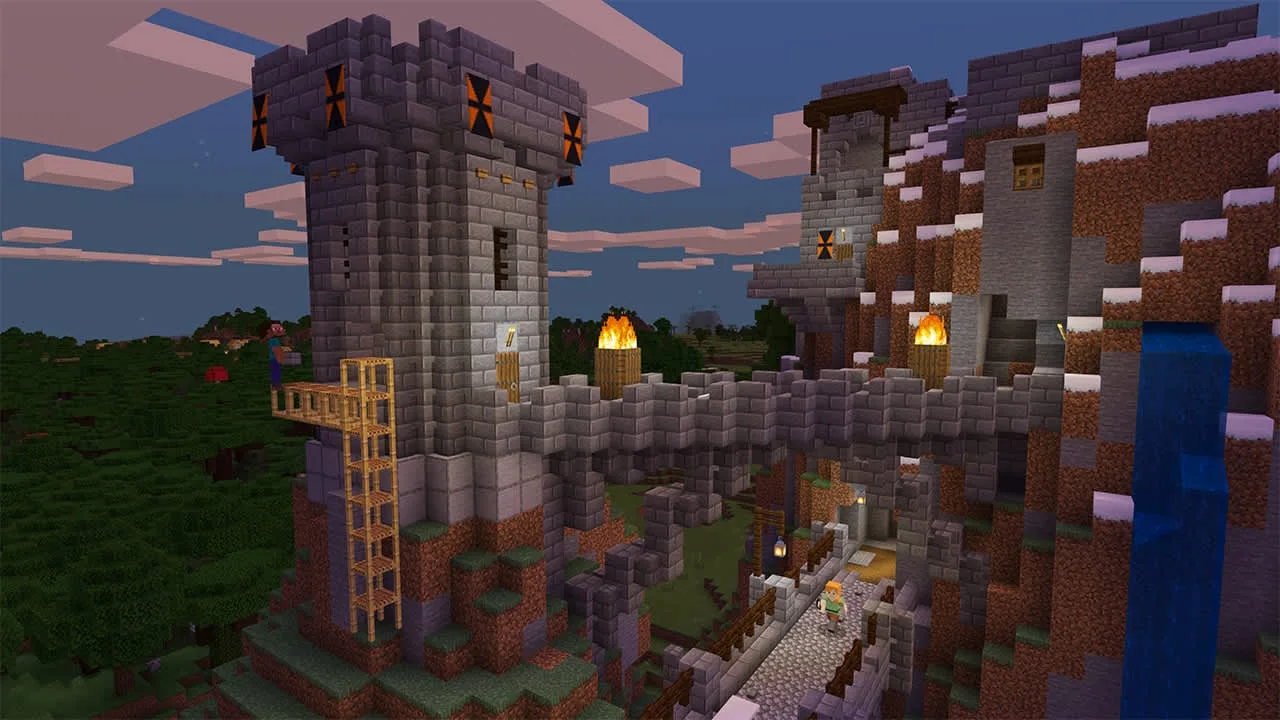
The bigger swing is Vibrant Visuals, the lighting and shading overhaul revealed at Minecraft Live 2025: directional shadows that move with the sun, volumetric fog, and water that actually reflects the world around it, toggleable at any time so purists can switch straight back to flat lighting. It shipped to Bedrock first and is still making its way to Java as Mojang migrates the whole engine from OpenGL to Vulkan through 2026 — a genuinely overdue technical modernization for a game whose renderer was showing its age, but one that's rolled out unevenly enough that which edition you're on determines whether you're looking at the old Minecraft or the new one on any given week.
Bedrock vs. Java, and the Marketplace Tax
This is the flaw that never gets fixed, because it isn't a bug — it's the business model. Buy Minecraft once and you get both Java and Bedrock editions, but they remain functionally separate games sharing a name. Bedrock is the cross-play version: PC, PlayStation, Xbox, Switch, and mobile players can all join the same world, and it's the edition console and phone players are stuck with. Java is Windows/Mac/Linux-only, can't cross-play with anything else, and in exchange gets the thing that actually matters most to a huge slice of the audience: an open modding ecosystem. Fabric and Forge let anyone install free, community-made mods that range from small quality-of-life tweaks to total conversions like Create, with no storefront in between the player and the mod author.
Bedrock's equivalent is the Marketplace, running on a virtual currency called Minecoins, where creators sell skins, texture packs, and Add-Ons at a real cost to the player and a revenue cut to Mojang — Add-Ons are also more restrictive than Java mods by design, sandboxed away from the kind of deep engine access Forge and Fabric allow. Multiplayer through Realms splits the same way: $9.99/month for Java, $7.99 for Bedrock, both keeping a private world running 24/7 without you hosting it, on top of which massive third-party server networks like Hypixel run entirely custom minigames for free. None of this makes either edition wrong to buy — Bedrock's console and cross-play reach is genuinely the better answer for most families and groups of friends, Java's mod scene is genuinely the better answer for PC players who want the deepest version of the game — but Mojang has never unified them, and fifteen years in, "which Minecraft did you buy" is still a real question with real consequences for who you can play with.
Verdict
Minecraft still earns the title it invented. The mine-craft-survive loop hasn't aged because it was never built around graphics or gimmicks in the first place, redstone gives it a technical ceiling nothing else in the genre has matched, and Mojang's shift to smaller, more frequent, year-numbered updates — plus a genuinely overdue Vulkan and lighting overhaul — proves this isn't a game running on inertia. The real cost of admission isn't the $29.99 asking price, which remains one of the best value propositions in gaming; it's accepting that Java and Bedrock are permanently different products wearing the same box art, one built for mods, one built for cross-play and a paid Marketplace, with no edition that cleanly gives you both. That split, plus an updates cadence that trades old-school scope for regularity, are the honest asterisks on an otherwise easy recommendation. For kids, for creative builders, for survival purists, and for anyone hosting a private server with friends, Minecraft in 2026 isn't just still the ultimate sandbox — it's a better version of itself than it was five years ago.
Pros:
- Mine-craft-survive core loop still generates its own stakes without a single scripted quest
- Redstone and crafter-block logic give it a computational depth no competitor has matched
- Vibrant Visuals and the Vulkan renderer migration are a real, overdue technical modernization
- One of the best price-to-content ratios in gaming at $29.99 for both editions
- Bedrock's full cross-play across console, PC, and mobile makes group play genuinely easy
- Java's free Forge/Fabric mod ecosystem remains unmatched in scope and creativity
Cons:
- Java and Bedrock remain permanently separate products — no cross-play between them, ever
- Bedrock's Marketplace charges real money (via Minecoins) for content Java gets free through mods
- Recent update drops are smaller and more frequent, which some longtime players read as reduced ambition
- Vibrant Visuals and engine changes are rolling out unevenly between editions
- Redstone's depth has effectively zero in-game guidance — you're learning it from wikis and YouTube, not the game itself

Jack reviews games for Gamingonix, judging every release on its own terms and telling you plainly whether it earns your time.