
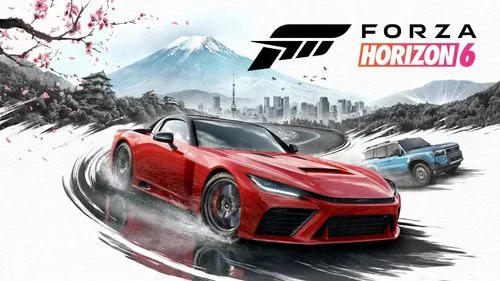
Forza Horizon has visited Mexico, Britain, Australia, Italy and France without ever going to the one country whose car culture practically invented half the vocabulary the series already uses — touge, drift, kei cars, JDM. Forza Horizon 6 fixes that. It launched May 19, 2026 on Xbox Series X|S and PC (Premium Edition owners got in four days early), with a PlayStation 5 version confirmed for later this year, and it currently sits at a 92 on Metacritic across 65 critic reviews — the highest-rated entry the series has produced. That score is earned less by reinvention than by Playground Games finally building a map and a driving culture that actually deserve each other.
Japan Is the Best Map the Series Has Built
Tokyo City alone is reportedly five times the size of Forza Horizon 5's Guanajuato, and it's only one region among rice paddies, mountain forests, coastal cliffs, snowy alpine passes, rural hamlets and a stadium built for the festival itself. What makes it work isn't just scale — Horizon 5's Mexico was plenty big and still felt thin in the empty stretches — it's density of reason to stop. A shrine tucked into a hillside, a switchback road that only makes sense once you've driven it, a fishing village you weren't steering toward but end up circling back to. Mount Fuji itself is unfortunately a backdrop rather than a drivable location (you can't summit it, though you can carve through the Tateyama Kurobe alpine snow walls nearby), which is a minor disappointment given how hard the marketing leaned on it, but it's a rare instance of restraint in a map that otherwise doesn't waste real estate. Seasons return and hit harder here than they did in Mexico — sakura season changes the palette of entire regions, not just the weather filter, and winter's snow doesn't just look different, it changes where a car's traction actually lives on a mountain road.
Touge Battles Are the One Genuinely New System, and It's a Good One
Most of what Forza Horizon 6 adds is refinement — new event types layered onto a structure the series has run five times already — but Touge Battles are the exception worth talking about. Touge, the mountain-pass duels at the heart of Japanese street racing culture, strips away the series' usual pack-of-eight chaos for something much tighter: two cars, a narrow winding road, no room for a bad line, decided by throttle control and braking points rather than raw horsepower. It's a genuine change of rhythm from the rest of the open world, closer to a rally stage than a Horizon race, and it's the clearest evidence in the whole game that Playground actually thought about what makes Japanese driving culture specifically different from the four countries they'd already covered — not just a reskin of an existing event type with new scenery.
The other headline addition, Auto Drive, is more of a quality-of-life tool than a system — it'll pilot you between events so you can sightsee or manage the menu without pausing — and it's genuinely useful on a map this dense with things to look at, even if it says more about how much Playground wants you to slow down and look at Japan than it does about new gameplay depth.
Everything Else Is Confidently the Same Game
Here's the honest complication: outside Touge Battles, Forza Horizon 6 does not reinvent the formula, and several critics have said so plainly. Showcase events, the festival progression structure, the way you unlock new areas and car classes — it's the same skeleton the series has run since Forza Horizon 3, polished rather than rebuilt. The new Journal system reorganizes how goals and challenges are tracked, and it's a cleaner UI than before, but it's still fundamentally the same checklist-driven festival loop. If you found Horizon 5's structure exhausting by the fifty-hour mark, nothing here changes your mind — it's the same game with better scenery and one new event type, and 550-plus cars is still an impressive number that mostly rewards people who were already going to grind for it.
Where the polish does show is under the hood, literally — the handling model across arcade, sport and simulation settings remains the most accessible in racing games without feeling shallow, and FM's physics groundwork clearly carries over into how a car actually loads its suspension through a touge hairpin.
The Drivatar Problem Playground Hasn't Solved
The one system complaint that's followed the game since launch is the Drivatar AI, and it's a real one, not a nitpick. On higher difficulties, opposing cars frequently post lap times and recovery speeds that don't read as skilled driving so much as a system quietly stretching grip and pace beyond what the same car does under your own control — rubber-banding dressed up as competition. Playground has publicly acknowledged the feedback, which is at least an admission the series hasn't fully cracked an AI model that's been a low-grade irritant since Horizon 4. It doesn't ruin the core loop, since most of Horizon is played solo against the clock or friends rather than the AI pack, but it undercuts the races where the AI is the actual point.
The writing hasn't improved either — festival hosts remain relentlessly, almost aggressively upbeat in a way that a few reviewers have flagged as grating rather than charming, and it's still the least essential part of any Horizon game, easily skipped past in menus.
Verdict
Forza Horizon 6 is the best version of a formula that hasn't meaningfully changed in three entries, and whether that's a five-star pitch or a mild disappointment depends entirely on how tired you were of that formula going in. Japan is a genuinely stronger map than anything the series has built before — denser, more varied, and finally paired with a driving culture that justifies the location instead of just decorating it — and Touge Battles prove Playground can still find a new idea worth building an entire event type around. But this is evolution, not reinvention: the festival structure, the Drivatar AI's rubber-banding, and the exhausting host dialogue are all carried over largely unexamined. Is it the best racing game yet? On handling, scenery and the sheer density of things worth doing, yes — measured against its own genre, not against some hypothetical reinvented Horizon nobody's actually made. Newcomers and series veterans who took a game or two off will find plenty to love. Anyone burned out on the checklist-festival structure itself should know that's still exactly what's on the menu.
Pros:
- Japan is the densest, most varied map the series has ever built, with seasons that meaningfully change how roads drive, not just how they look
- Touge Battles are a genuinely new, tightly designed event type built around real Japanese driving culture
- The handling model remains the most approachable in racing games without sacrificing depth
- 550-plus cars and a cleaner Journal progression system for tracking goals
Cons:
- Drivatar AI rubber-bands noticeably on higher difficulties, and Playground has only acknowledged the issue, not fixed it
- The festival structure, showcase events and progression loop are essentially unchanged from Horizon 5
- Festival host dialogue is as relentlessly upbeat and skippable as ever
- Mount Fuji itself is a backdrop, not a drivable location, despite how heavily it featured in marketing
Jack reviews games for Gamingonix, judging every release on its own terms and telling you plainly whether it earns your time.