
Most games get reviewed once and stay reviewed. Fortnite doesn't work that way — it's been re-released, re-skinned, and structurally rebuilt so many times since 2017 that "reviewing Fortnite" in 2026 means reviewing a moving ecosystem, not a fixed product. This is the game that just quietly shut down three of its own modes, brought Sonic the Hedgehog and Pac-Man into the same battle royale island, made its original PvE campaign free after eight years of charging for it, and is fighting Apple in front of the Supreme Court over how you're allowed to pay for V-Bucks. None of that is hyperbole for a press release. It's Tuesday for Epic Games. The question worth answering isn't whether Fortnite is still popular — it obviously is — but whether the thing you'd actually install today holds up as a game, given everything Epic has added, cut, and monetized around the core of it.
Chapter 7, Season 4: The Battle Royale Core Still Works
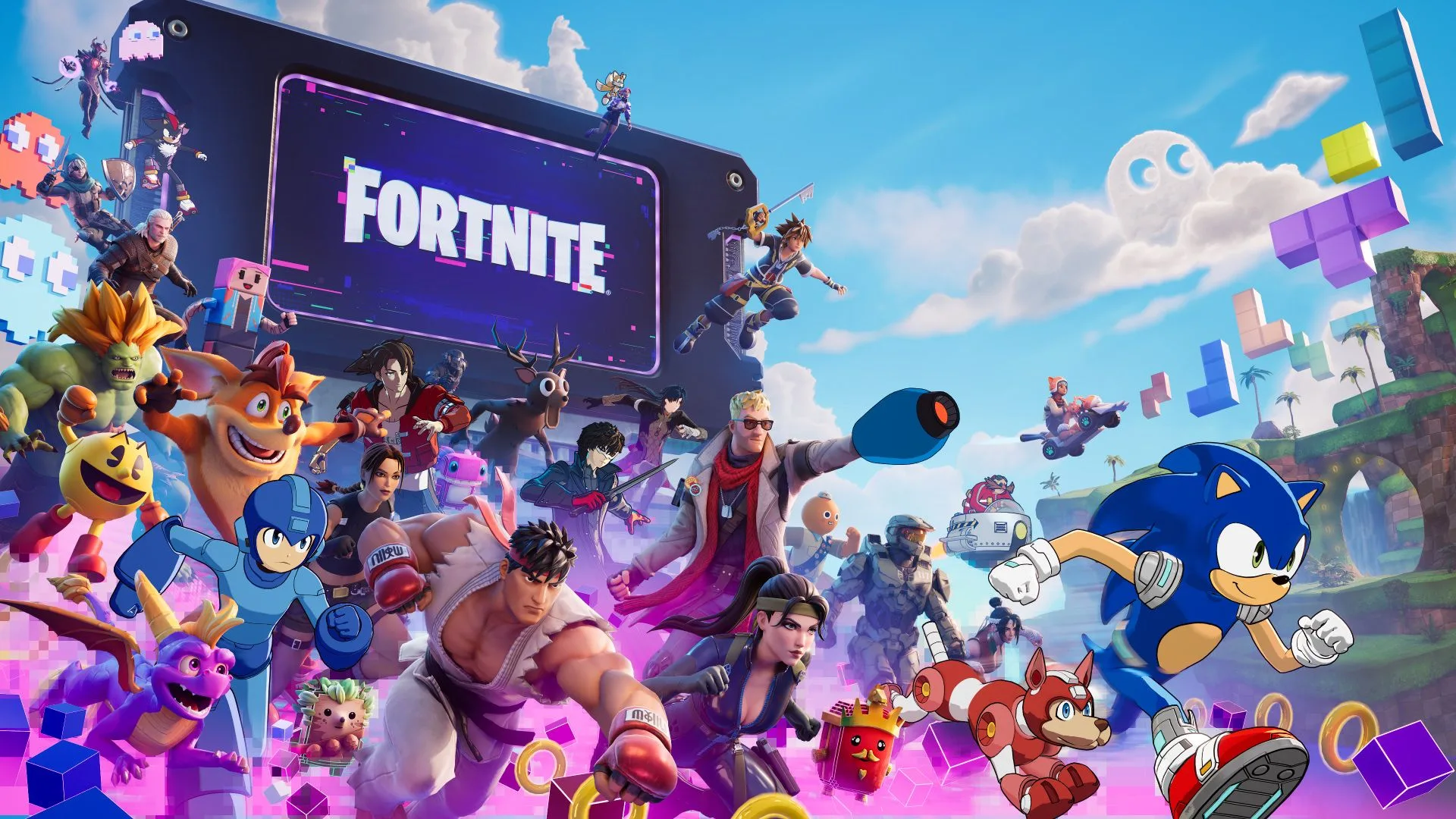
Strip away everything else and Fortnite's battle royale is still a tightly tuned hundred-player shooter with a build mechanic nothing else has fully replicated, and Chapter 7 Season 4 — subtitled Override, live since August 20 and running through November 1 — is a decent showcase of why that loop endures. The season leans into a full retro-gaming crossover: Sonic the Hedgehog headlines the Battle Pass alongside Wrixel, an original pixel-cube character, and the map swapped out Calamari Canyon, Frosted Flats, and Sinister Strip for Geno's HQ, a Sonic-themed Green Hills Zone, Pac-Man Island, and a Tetris-block-strewn Temple and Spire. Landing in Green Hills and immediately recognizing Sega's checkerboard hills rendered in Fortnite's art style is a genuinely fun bit of crossover execution, not just a logo slapped on a poster.
Mechanically, the season adds nothing revolutionary — new POIs, a rebalanced loot pool, the usual mythic weapons tied to named NPCs — but that's fine, because the two things that actually matter (build-mode combat for players who want the skill ceiling, and a fully supported Zero Build playlist for players who don't) remain intact and well-balanced against each other. Epic solved the biggest fracture point in its own playerbase years ago by simply running both permanently instead of picking one, and that decision is still paying off; it means recommending Fortnite doesn't require asking "which Fortnite" the way it used to.
The Great Sunsetting: Rocket Racing, Ballistic, and Festival Battle Stage Are Gone
Here's the part that changes the shape of a 2026 review versus one from two years ago: Epic has been actively shrinking its "Fortnite as five games in one hub" pitch. Ballistic, the tactical 5v5 mode built to chase Valorant and CS2 players, was pulled entirely in the April 2026 update. Festival's competitive Battle Stage mode went offline the same month. And Rocket Racing — the Rocket League-adjacent kart racer that got its own standalone app push in 2024 — is being removed from the main game and UEFN's template tools by October 2026, with only your customized vehicle locker surviving the cut. Festival's Main Stage and Jam Stage, the actually-popular rhythm-game side of that mode, are staying and reportedly getting more investment.
Read together, that's Epic admitting the "hub of games" strategy overextended. Three modes launched with real marketing weight, real dedicated menus, and in Rocket Racing's case a whole spinoff app, and none of them held an audience worth the maintenance cost. It's a defensible business call, but it's worth being honest about what it means for anyone who bought cosmetics or battle passes tied to those modes: that spend bought access to something with a countdown timer nobody told you was running.
LEGO Fortnite Odyssey and Save the World's Overdue Free-to-Play Pivot
Not everything got cut. LEGO Fortnite — the survival-crafting mode built with actual Lego Group involvement — was reorganized this year into a broader hub, with the original survival game renamed LEGO Fortnite Odyssey to make room for spinoff modes underneath the same brand. It's still the closest thing Fortnite has to a cozy, non-competitive alternative to getting shot at, and it remains legitimately well-built as a Minecraft-adjacent crafting loop rather than a reskin.
The bigger story is Save the World, Fortnite's original 2017 PvE campaign, which spent eight years as a paid legacy mode nobody outside a shrinking core audience touched. In April 2026, Epic finally made it free-to-play and brought it to Switch 2 for the first time, taking advantage of hardware the original Switch couldn't handle. It's a genuinely good-faith move — folding one of the last paywalled corners of the game into the free ecosystem — undercut slightly by the fact that, as of this writing, the Switch 2 version is temporarily down with an update error Epic says it's still fixing. Old Fortnite habits die hard.
UEFN Is Doing More Work Than Any Single Mode
The mode that matters most in 2026 barely looks like a mode at all: Unreal Editor for Fortnite, Epic's full creation suite, has become the actual engine driving the game's longevity. Rocket Racing's death is telling here too — rather than kill the underlying tech, Epic is folding its car physics, track-building tools, and hazard devices directly into UEFN's base toolset, letting creators build their own racing islands instead of Epic maintaining one official mode. That's the pattern across the board: original modes get retired, but the systems behind them get handed to the creator ecosystem, which now produces everything from horror escape rooms to 1v1 aim-training maps to full narrative RPGs, some of which get more concurrent players on a given weekend than the modes Epic built in-house ever did.
It's the smartest structural bet Epic has made post-Metaverse-hype, and it's also the part of Fortnite least visible to a player who only logs in for battle royale. If you've never opened the Discover tab, you're missing the half of the game that's actually expanding.
The Money: Crew, V-Bucks, and the Apple Fight You're Paying Into
Fortnite Crew, the monthly subscription bundling the Battle Pass, OG Pass, LEGO Pass, and Music Pass, still runs $11.99 a month — but in June 2026 Epic quietly cut the included V-Bucks from 1,000 to 800 without touching the price, a real-terms price increase dressed as a UI change. The standalone Battle Pass now costs 800 V-Bucks and pays back 800 on completion, which is fair on paper but assumes you're already playing enough to grind it out. Xbox Game Pass Ultimate subscribers get Crew bundled free as of late 2025, which is the single best value entry point into any of this if you already pay for Xbox's subscription.
The bigger story is platform, not price: after years of exile, Fortnite returned to the iOS App Store worldwide in May 2026, with Epic framing it as the opening move in what CEO Tim Sweeney calls a "final battle" with Apple — a fight that escalated to the U.S. Supreme Court agreeing in June 2026 to hear Apple's appeal over the 27% fee Apple still charges on external payment links. Notably, Fortnite still isn't back in Australia, where Epic says it won its court case but Apple is refusing to comply with the ruling. None of this changes how Fortnite plays, but it does mean the platform you install it on, and how you pay for V-Bucks on it, is still a live legal argument rather than a settled fact.
Verdict
Fortnite in 2026 is a smaller, more focused game than the "everything hub" Epic was building toward a couple of years ago, and mostly that's an improvement — Ballistic, Battle Stage, and Rocket Racing were spread thin, and cutting them loose while feeding their tech into UEFN's shared toolset is a better use of Epic's resources than propping up three underperforming modes indefinitely. The battle royale core, split cleanly between build and Zero Build, is still the best version of itself it's been in years, and Chapter 7's retro-crossover season is genuinely well-produced rather than just a licensing stunt. But the crossover fatigue critics keep pointing to is real — the item shop rotates so fast it's hard to tell what's a limited event and what's permanent, and the Crew V-Bucks cut is the kind of quiet monetization erosion that's easy to miss until you notice your subscription buys less than it did last year. Fortnite hasn't stopped being worth playing. It's just stopped being one simple thing to recommend, and you should go in knowing which parts of it are actually thriving before you decide which battle pass is worth your money.
Pros:
- Build and Zero Build battle royale remain genuinely well-balanced against each other, not a compromise between two worse modes
- Chapter 7 Season 4's retro-gaming crossover (Sonic, Pac-Man, Tetris) is well-produced, not a shallow licensing skin
- UEFN's player-made islands are the real growth engine now, offering more variety than Epic's own first-party modes ever did
- Save the World finally went free-to-play in 2026 after eight years as a paid legacy mode
- Cross-play and cross-progression across every platform remain best-in-class
Cons:
- Rocket Racing, Ballistic, and Festival Battle Stage were all sunsetted in 2026, stranding anyone who invested cosmetics or time in them
- Fortnite Crew quietly cut its monthly V-Bucks allotment by 20% in June 2026 without lowering the price
- Item shop and crossover turnover is fast enough that "collab fatigue" is now a real, common player complaint
- Save the World's new Switch 2 release has been down with update errors at launch
- Still not available in Australia due to the unresolved Epic v. Apple legal standoff
Jack reviews games for Gamingonix, judging every release on its own terms and telling you plainly whether it earns your time.