
No Call of Duty has ever split this cleanly down the middle. Black Ops 7 is, by the near-universal agreement of critics, the best the series' multiplayer has felt in years — tighter Omnimovement, smarter maps, a genuinely good new mode in Overload. It is also, by an even more lopsided consensus of the people who actually bought it, the worst-received Call of Duty campaign ever shipped, landing a Metacritic user score of 1.7 against a critic average in the mid-60s and dropping to "Mostly Negative" on Steam inside its first week. Almost a year after its November 2025 launch, now nine months into a Season 5 live-service cycle, that gap hasn't closed so much as calcified into the defining fact of this game: Treyarch nailed the half of Call of Duty people actually play for hundreds of hours, and torched the half that's supposed to sell the box.
Multiplayer Is the Real Reason to Buy This
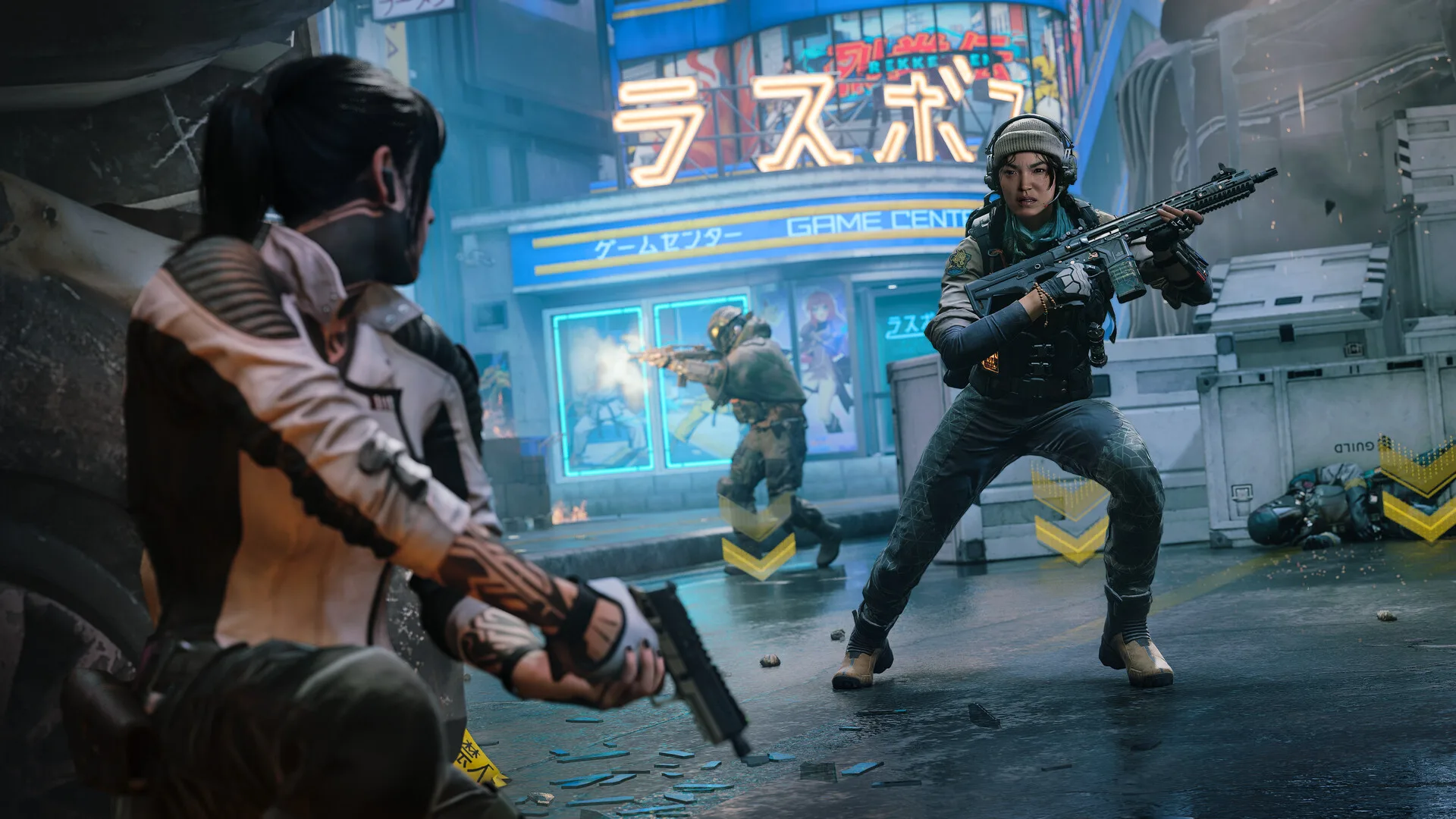
Strip away everything else and the core shooting here is excellent. Omnimovement — the slide-dive-dolphin-kick traversal system Black Ops 6 introduced — gets refined rather than reinvented, with small, chainable wall jumps added on top. It sounds like a minor tweak next to a mechanic that was already a big deal a year ago, but in practice it changes how firefights in tight corridors read: a wall tap lets you peek an angle, break a sightline, or bail out of a lost duel in a way that feels genuinely new rather than cosmetic. Gunplay is crisp, time-to-kill is readable, and the map rotation at launch is some of the strongest Treyarch has put out in a decade — built for the movement system rather than retrofitted to it.
The standout addition is Overload, an attack-and-defend mode built around capturing an EMP device and hauling it into one of two zones on the enemy's side of the map. It's a smarter twist on the control-point formula than anything the series has tried recently, rewarding coordinated pushes rather than individual frags, and it's the one new idea in Black Ops 7 that reviewers across the board singled out without a caveat attached. Five seasons of post-launch support have kept new maps and modes flowing at a reasonable clip, and if your entire relationship with Call of Duty is ranked play and casual lobbies with friends, this is a legitimately strong year for that relationship.
The caveat, and it's not a small one: get outside the critic-review window and the matchmaking experience gets messier. Community complaints about cheaters in public lobbies, inconsistent skill-based matchmaking, and reports of shadow-bans hitting legitimate players have followed the game through its first year, the same unresolved category of problem that's dogged Call of Duty's online space for several entries running. The shooting itself hasn't lost a step. Trusting that the person on the other end of the kill cam got there legitimately is still a coin flip.
Avalon and the Campaign That Broke the Internet's Patience
This is where Black Ops 7 earns its reputation, and it's worse than "disappointing." The campaign follows Frank Woods and a JSOC team investigating a returned Raul Menendez and an organization called the Guild, which is planning to destabilize the world using a hallucinogenic compound called the Cradle — a premise that gives Treyarch license to turn large stretches of the story into what multiple outlets independently described as an acid trip, complete with surreal set pieces that abandon any pretense of grounded military fiction. Ambition for its own sake isn't automatically a flaw; the problem is execution. Reviewers flagged clinical, flavorless dialogue, mission design several called "amateurish," and a late giant boss fight built around a distorted Michael Rooker that became the single most-mocked moment in the game's launch window.
It got worse from there. Activision confirmed the use of generative AI in some in-game assets — menu art, cosmetics, promotional material — which, dropped into a campaign already being torn apart for feeling hollow and incoherent, became the spark that turned "bad campaign" into "this is what's wrong with the whole industry" discourse. That controversy is a meaningful part of why the user-review collapse was this severe; it's not just that people didn't like the story, it's that the story's quality read as evidence the studio had stopped trying to write one.
Structurally, the campaign leans on Avalon, an open map originally built for Warzone and repurposed as a connective hub between missions, and Endgame, a new extraction-style PvE mode that has you grinding activities to build a combat score before a final boss push. Avalon's scale works against it — reviewers noted long treks between objectives that grapple hooks and wingsuits only partially offset — and Endgame, while a genuinely different structural idea for a Call of Duty campaign, mostly reads as a mode in search of a reason to exist rather than a satisfying climax. Co-op campaign support for up to four players is a nice, underused perk if you've got friends willing to suffer through it with you, but it doesn't fix pacing or writing that don't hold up solo either.
Zombies Gets Its Identity Back
The one piece of PvE that critics and the community actually agree on is Zombies, and specifically its return to round-based structure after the series spent recent entries chasing open-world and extraction formats. Ashes of the Damned, the launch map, has been widely described as the largest round-based Zombies map the series has built, stitched together with fog-covered connecting roads between distinct zones — a big, ambitious map that mostly earns its size. Five more round-based maps have followed across the seasonal calendar through Season 5, keeping the Dark Aether storyline moving at a pace longtime Zombies players will recognize.
The smarter move is Survival, a stripped-down mode making its first appearance since Black Ops 2: no quests, no Easter egg chains, just you and a squad against escalating waves on a trimmed-down slice of a round-based map. It's a direct answer to the complaint that Zombies had gotten too dense and homework-heavy for anyone who just wants to log on and shoot the undead for forty-five minutes, and it works exactly as advertised. If Black Ops 7 has an unqualified success story, Zombies is it — a mode that remembered what made the format popular in the first place and didn't try to reinvent it into something else.
Is It Worth Buying?
At $69.99 for the standard edition and $99.99 for the Vault Edition bundling operator skins and mastercraft weapons, Black Ops 7 is priced like every other full-price Call of Duty, and day-one inclusion on Xbox Game Pass Ultimate is the detail that actually changes the math most for a lot of players — if you've already got the subscription, this is close to a free look at a genuinely strong multiplayer mode, no purchase risk attached. Buying it outright for the campaign alone is a bad trade by every account from critics and players; buying it outright for multiplayer and Zombies, with the campaign treated as a curiosity you finish once and never revisit, is a far more defensible $70. Compared to Black Ops 6, the shooting here is a real, felt improvement — the wall-jump additions to Omnimovement and Overload's mode design are not marginal — but Black Ops 6's launch didn't carry anything close to this level of reputational damage, and that gap matters if you're the kind of buyer who cares whether a studio's current goodwill matches the price being asked.
Verdict
Black Ops 7 is two games sharing a disc, and they are not close to the same quality. The multiplayer is some of the tightest, most purposeful shooting Treyarch has built in a decade, Overload is a genuinely good new idea, and Zombies' return to round-based basics with Survival mode layered on top is exactly the course correction longtime fans wanted. None of that erases a campaign that critics called amateurish and players rejected hard enough to make it the worst user-reviewed entry in the franchise's history, nor the generative-AI asset controversy that turned a mediocre story into a trust problem. If you're buying this for the single-player, don't — rent it through Game Pass if you're curious and move on. If you're buying it for ranked lobbies, squad nights, and round-based Zombies with friends, there's a legitimately excellent shooter underneath the wreckage, and it's worth the price of admission on that basis alone.
Pros:
- Omnimovement's new chainable wall jumps meaningfully improve traversal and close-quarters combat over Black Ops 6
- Overload is a smart, coordination-rewarding attack-and-defend mode and the best new idea in the package
- Zombies' return to round-based structure, plus the reintroduced Survival mode, is a genuine course correction
- Day-one on Xbox Game Pass Ultimate makes this close to a no-risk try for subscribers
Cons:
- The campaign is the most critically and commercially panned in series history, with amateurish writing and a widely mocked final boss fight
- Confirmed use of generative AI in in-game assets became a trust-breaking controversy on top of an already weak story
- Avalon's oversized, Warzone-derived map design and the Endgame mode add length without adding satisfaction
- Persistent community complaints about cheating, SBMM, and shadow-bans in public multiplayer lobbies remain unresolved a year in
Jack reviews games for Gamingonix, judging every release on its own terms and telling you plainly whether it earns your time.