
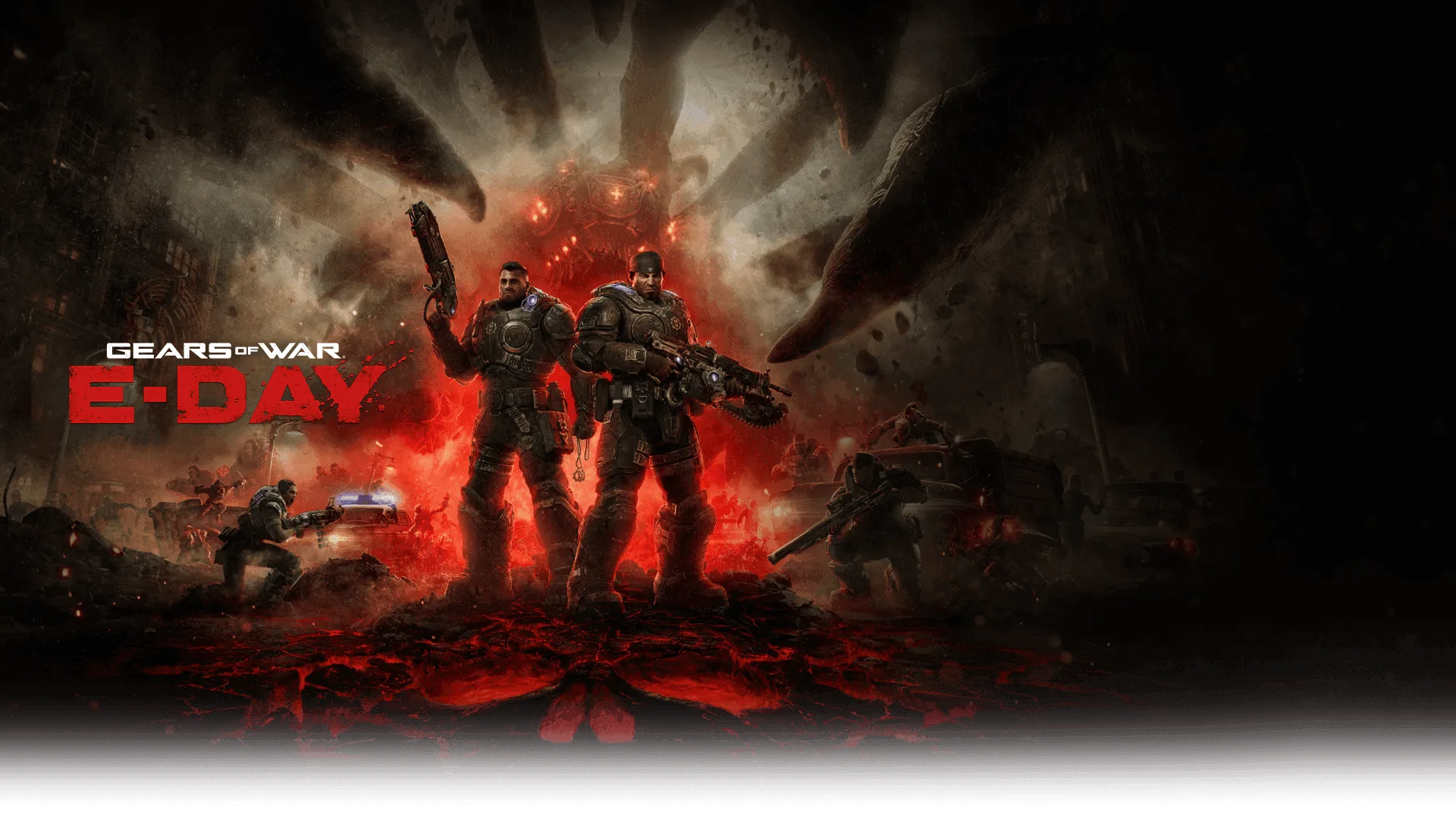
Gears of War has always been a series about the day after the worst thing happens — Marcus Fenix already in Jacinto's rubble, the Locust already surfaced, the war already fourteen years old by the time the original trilogy starts. E-Day is the first Gears game built around the worst thing itself. This is Emergence Day: the hour the Locust Horde erupts out of the ground beneath the city of Kalona and a world that didn't know war was coming gets one anyway. The Coalition has had this pitch sitting in a drawer since at least 2020's reveal trailer, and now that it's actually here — Early Access opened October 1 for Premium and Collector's Edition owners, full release follows October 6 on Xbox Series X|S, PC and Steam — the verdict forming across the first wave of hands-on reviews is a familiar Gears shape: a genuinely great shooter wrapped around a story that doesn't trust itself to be new.
Worth saying up front, because it matters to how to read everything below: this is being written during the Early Access window, with the broader critical conversation still forming around a roughly 20-hour campaign most outlets have only partially finished. The shooting, the systems and the moment-to-moment feel are assessable now. The full shape of the back half of the story is still coming into focus industry-wide. What follows is a verdict on the game as it stands today, not a claim to have seen everything it has to show.
The Best Gears Has Shot in Years
The headline, and the one nearly every early review agrees on, is that the gunplay is the strongest the series has produced since its Xbox 360 peak. The Lancer's chainsaw bayonet still does the thing it's always done — revs, catches, and turns a Locust Drone into chunks with a sound design that hasn't lost a bit of its crunch — but the system around it has actually moved forward for the first time in a decade. The Coalition has finally given players vertical movement: you can jump, vault and climb structures, and slide out of a sprint into cover, which sounds like a small addition next to a chainsaw gun but fundamentally changes how a firefight in Kalona's ruined streets reads. Cover in Gears has always been about lateral positioning along a wall; E-Day adds a vertical axis to that math, and an adaptive cover system that lets emplacements crumble and shift mid-fight keeps you from ever treating a chokepoint as permanently safe.
The other real addition is a weapon mod system — attachments and upgrades you collect and swap between encounters, which gives the Lancer, Gnasher and Torque Bow a layer of build-crafting the earlier games never bothered with. It's not deep in the way a looter-shooter's gear tree is deep, but it's enough to make "which gun do I carry into this fight" a real question instead of a formality. None of this changes what Gears fundamentally is — a stop-and-pop cover shooter where a wrong push gets you downed in two shots — but it's the clearest evidence that this is a studio trying to earn the "Halo 3: ODST moment" framing some reviewers have already reached for, rather than just reskinning a fifteen-year-old engine.
Horror Before the Horde Becomes Routine
E-Day's smartest structural choice is tonal, not mechanical. Because this is the actual day of the invasion rather than the fourteenth year of a grinding war, the opening hours play as something closer to survival horror than war shooter — Locust aren't a known quantity yet, ammo is scarce, and an early sequence set in a Kalona police station has been compared directly to Resident Evil 2's Raccoon City precinct: corridors you don't want to walk down, a sense that something underground is about to come up through the floor rather than charge you across open ground. It's a register the series has never worked in before, and it's the single best argument for E-Day existing as a prequel at all — it gets to show the Locust Horde as something genuinely unknown and frightening, a feeling the increasingly bullet-spongy later trilogy entries spent their sequels flattening out.
The problem is that this is also exactly where the story's central tension lives and dies. You already know Marcus Fenix and Dominic Santiago survive this day — they're the protagonists of three subsequent games — which means every "will they make it" beat the campaign leans on is hollow by construction. Several reviews have landed on this as the defining flaw: the stakes stay low because the outcome was locked in back in 2006, and a story that leans this hard on dread needs either new characters to actually put at risk or a willingness to swerve from canon that a prequel built for returning fans was never going to take.
Twenty Hours Is a Lot of One Note
The campaign's length has become the most contested part of the Early Access conversation. At upward of 20 hours, E-Day is roughly double the length of a classic Gears campaign, and multiple reviews-in-progress have flagged that as a miscalculation rather than a value-add — the core loop of clear-a-room, push-cover, clear-the-next-room doesn't meaningfully vary enough across that runtime to justify it, and by the back half of Act 3 the horror-tinged opening has given way to the same wave-based attrition the series has always fallen back on. One widely echoed line from this week's coverage calls it a campaign "trapped in a slog" that's otherwise "anything but" — a game with excellent shooting that overstays its welcome because nobody trimmed it down to the ten-or-so hours its pacing could actually support. That's a real tension worth sitting with: the mechanical improvements are the best reason to play this campaign, and the campaign's length is the thing most likely to make you stop finishing it.
Horde Siege Is Where the New Ideas Live
Multiplayer is where The Coalition took the bigger swing, and it mostly pays off. Horde Siege is the headline addition: a 12-player cooperative mode where three four-person teams defend districts of Kalona simultaneously, working through waves and objectives before converging on a single boss encounter and extracting together. It sits alongside the classic four-player Horde format rather than replacing it, which is the right call — players who want the tighter, more readable version of the mode still have it, while Horde Siege gives large groups something to coordinate around at a scale Gears has never attempted. Three Horde Siege maps ship at launch, spread across different parts of the city, which is a reasonable amount of content for a mode this new but thin if it's meant to carry the game's live-service ambitions on its own.
Versus multiplayer gets four modes — Team Deathmatch, Conquest, Demolition and the returning Crucible — across six new maps, none of which reinvents what competitive Gears has always been: methodical, cover-reliant, and punishing for players who push without a plan. It's solid, familiar ground rather than new ground, which after the horror-tinged ambition of the campaign's opening feels like the safer half of the package.
Performance Is Uneven Depending on Where You Play
Technically, E-Day is a tale of two Xboxes and a demanding PC port. On Series X, the campaign targets native 4K at 60fps with ray tracing active, and the city of Kalona is genuinely one of the best-looking environments the series has produced — immaculate lighting, dense debris and rubble detail, character models that hold up in close-up cutscenes. Series S is a much rougher story: independent technical analysis measured internal render resolutions averaging around 576p in Performance mode and 792p even in Quality mode, with frame-time spikes and stutters in the game's larger, more open areas. On PC, the game is brutally demanding at its highest "Ludicrous" preset — even some of the fastest current GPUs struggle to hold a clean frame rate at 1440p and 4K maxed out — and reviewers have reported stuttering specifically in the more open refinery environments around Act 4, suggesting shader compilation or streaming hitches that haven't been fully ironed out for this Early Access build. None of this sinks the game, but if you're playing on Series S or a mid-range PC, go in expecting to drop settings rather than chase the marketing screenshots.
Verdict
Taken as what it currently is — an Early Access build with full release four days away and the wider critical picture still settling — Gears of War: E-Day is a genuine mechanical step forward wearing a story that never figures out how to make a foregone conclusion feel urgent. The shooting is the best the series has offered since its original run: the new vertical movement and weapon mods finally give the Lancer-and-cover formula room to breathe, the opening hours' horror tone is a legitimately new register for Gears, and Horde Siege is a smart, scalable addition to the mode that made this series' multiplayer legacy in the first place. But a 20-hour campaign that leans on a horror atmosphere it can't sustain, stakes undercut by its own prequel premise, and a Series S and PC experience that needs more optimization passes keep this from being the clean return to form its best moments promise. If you came for the feel of a Lancer in your hands and a Locust Drone in your sights, this is the best that's felt in years. If you came hoping the story finally had something new to say about the day Sera ended, you'll be waiting for a sequel that's allowed to actually surprise you.
Pros:
- The best core cover-shooting and chainsaw combat the series has produced since its Xbox 360 era, elevated by new vertical movement and a genuine weapon mod system
- The E-Day setting lets the Locust Horde feel unknown and frightening again, with an early horror-tinged stretch unlike anything the series has tried before
- Horde Siege's 12-player, three-squad structure is a smart scale-up that sits alongside — rather than replacing — the classic Horde format
- Kalona is one of the best-looking environments in the series, with Series X holding a clean 4K/60 target with ray tracing on
Cons:
- A roughly 20-hour campaign stretches a one-note cover-and-clear loop well past where the pacing can sustain it
- The prequel premise undercuts its own tension — you already know Marcus and Dom survive E-Day
- Xbox Series S performance is rough, with internal resolutions dropping well below 1080p and frame-time stutters in open areas
- PC performance at maximum settings is punishing even on high-end hardware, with reported stuttering in Act 4's more open environments
Jack reviews games for Gamingonix, judging every release on its own terms and telling you plainly whether it earns your time.